This article is about the tennis tournament. The US Open Tennis Championships, commonly called the US Open (stylized in all lowercase), is a hardcourt tennis tournament organized by the United States Tennis Association annually in Queens, New York City. The US Open starts on the Sunday immediately preceding the last Monday of August[2] and continues for two weeks, with the middle weekend coinciding with the United States Labor Day holiday. All players participating must be at least fourteen years old.
Historie a vývoj turnaje
The tournament originally took place in Newport, Rhode Island from its inception until 1914. The tournament consists of five primary championships: men's and women's singles, men's and women's doubles, and mixed doubles. The tournament also includes events for senior, junior, and wheelchair players. Since 1978, the tournament has been played on acrylic hardcourts at the USTA Billie Jean King National Tennis Center in Flushing Meadows-Corona Park, Queens, New York City.
Změny pravidel a povahy soutěží
This tournament, from 1971 to 2021, employed standard tiebreakers (first to seven points, win by two) in every set of a singles match.[3] Since 2022, revised tiebreak rules were initiated and standardized in the final set for all four majors, where if a match reaches six-all in the final set (the third for women and fifth for men), an extended tiebreaker (first to ten points, win by two) is played.
Kořeny a místa konání
The tournament was first held in August 1881 on grass courts at the Newport Casino in Newport, Rhode Island, which is now home to the International Tennis Hall of Fame. National Championships from 1881 to 1886. It had both a singles and doubles division. Women's National Singles Championship was held at the Philadelphia Cricket Club in 1887. The winner was 17-year-old Philadelphian Ellen Hansell. Tennis Championships at Newport, Rhode Island. The women's tournament used a challenge system from 1888 through 1918, except in 1917. The 1888 and the 1889 men's doubles events were played at the Staten Island Cricket Club in Livingston, Staten Island, New York.[9]
In 1915, the national championships was relocated to the West Side Tennis Club in Forest Hills, Queens, New York City. In early 1915, a group of about 100 tennis players signed a petition in favor of moving the tournament. They argued that most tennis clubs, players, and fans were located in the New York City area and that it would therefore be beneficial for the development of the sport to host the national championships there.[14] This view was opposed by another group of players that included eight former national singles champions.[15][16] This contentious issue was brought to a vote at the annual USNLTA meeting on February 5, 1915, with 128 votes in favor of and 119 against relocation.[17][18][19] In August 1915, the men's singles tournament was held at the West Side Tennis Club, Forest Hills in New York City for the first time, while the women's tournament was held at the Philadelphia Cricket Club in Chestnut Hill, Philadelphia (the women's singles event was not moved until 1921).
Významné milníky a provozní detaily
From 1917 to 1933, the men's doubles event was held at the Longwood Cricket Club in Chestnut Hill, Massachusetts. The Open Era began in 1968 when professional tennis players were allowed to compete for the first time at the Grand Slam tournament held at the West Side Tennis Club. National Championships had been limited to amateur players. Except for mixed doubles,[citation needed] all events at the 1968 national tournament were open to professionals.
That year, 96 men and 63 women entered, and prize money totaled $100,000. In 1970, the US Open became the first Grand Slam tournament to use a tiebreaker to decide a set that reached a 6-6 score in games. From 1970 through 1974, the US Open used a best-of-nine-point sudden-death tiebreaker before moving to the International Tennis Federation's (ITF) best-of-twelve points system.[6]
In 1973, the US Open became the first Grand Slam tournament to award equal prize money to men and women, with that year's singles champions, John Newcombe and Margaret Court, receiving $25,000 each.[6] Beginning in 1975, following complaints about the surface and its impact on the ball's bounce, the tournament was played on clay courts instead of grass. This was also an experiment to make it more "TV friendly". In 1978, the tournament moved from the West Side Tennis Club to the larger and newly constructed USTA National Tennis Center in Flushing Meadows, Queens, 3 miles (4.8 km) to the north. The tournament's court surface also switched from clay to hardcourt.
Moderní rozměry a infrastruktura
In 2005 the US Open added Wheelchair singles and Wheelchair doubles tournament, while in 2006 the US Open added the Quad singles and Quad doubles tournament. With the move to Flushing, the women's final was played between the two men's semi-finals on Saturday, creating a block that came to be known as "Super Saturday". While fan-friendly, the concept proved divisive among players because it gave them less than a day's rest between the semifinal and championship matches.
For five consecutive tournaments between 2008 through 2012, the men's final was postponed to Monday due to weather. In 2015, the US Open returned to a format similar to the other Grand Slams, with women's and men's finals on Saturday and Sunday, and players having an extra day of rest. In 2020, the event was held without spectators due to the COVID-19 pandemic; the Western & Southern Open was also re-located from Cincinnati in order to create a bio-secure bubble for both events due to their proximity.[41]
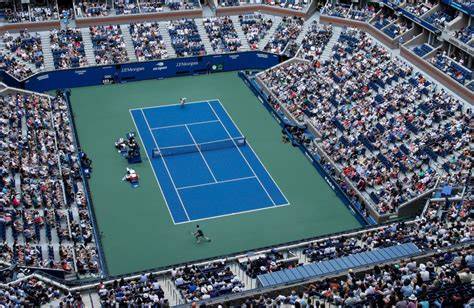
An announcement that the wheelchair tennis competition would not be held caused controversy, protože the USTA did not consult with athletes prior to it, as it had with the players' organizations for the able-bodied competitions. The main court is the 23,771-seat[46] Arthur Ashe Stadium, which opened in 1997. A US$180 million[47] retractable roof was added in 2016.[48] The stadium is named after Arthur Ashe, who won the men's singles title at the inaugural US Open in 1968, and was inducted into the International Tennis Hall of Fame in 1985. The next largest court is the 14,061-seat Louis Armstrong Stadium, which cost US$200 million to build and opened in 2018.[47] The 6,400-seat lower tier of this stadium is separately ticketed, reserved seating while the 7,661-seat upper tier is general admission and not separately ticketed.[47][49] The third largest court is the 8,125-seat Grandstand in the southwest corner of the grounds, which opened in 2016.[48] Court 17 in the southeast corner of the grounds is the fourth largest stadium.
All the courts used by the US Open are illuminated, allowing matches and television coverage to extend into the evening. From 1978 to 2019, the US Open was played on a hardcourt surface called Pro DecoTurf. In 2006, the US Open introduced instant replay reviews of line calls, using the Hawk-Eye computer system. It was the first Grand Slam tournament to use the system.[57] The Open felt the need to implement the system because of the controversial quarterfinal match at the 2004 US Open[citation needed] between Serena Williams and Jennifer Capriati, where a number of important line calls went against Williams. Replays on TV showed these calls were incorrect, including one critical point in the match that was incorrectly overruled by the chair umpire.[58] Instant replay was available only on the Arthur Ashe Stadium and Louis Armstrong Stadium courts through the 2008 tournament. In 2009, it became available on the Grandstand court.[citation needed] In 2018, all competition courts were outfitted with Hawk-Eye, a všichni hráči mohli využít tři nesprávné výzvy na set, s jednou přidanou v tiebreaku.
Odměny a ekonomika turnaje
Ranking points for the men (ATP) and women (WTA) have varied at the US Open through the years. The men's and women's singles champions each received a record $5.5 million, with the runners-up receiving $2.8 million. First-round singles prize money increased by 27% to $140,000, while first-round qualifying prize money increased by 16% to $32,000. In 2012, the USTA agreed to increase the US Open prize money to $50.4 million by 2017. As a result, the prize money for the 2013 tournament was $33.6 million, a record $8.1 million increase from 2012. The 2023 tournament saw another record, with total prize money reaching $65 million. Efforts were also undertaken to enhance support for participants across all events by implementing expanded player expense assistance measures. This iteration of the tournament introduced substantial changes in player per diem allowances, extending to all competitors. Travel vouchers worth $1,000 have been newly introduced. Moreover, players can receive an additional hotel room or witness a twofold increase in their daily hotel allowance, which has been raised from $300 to $600, provided they choose alternate lodging. In 2026, total player compensation reached a record $108 million, a 20% increase from the $90 million offered in 2025 and a 44% increase over two years. It marked the second consecutive year in which the US Open increased its total player compensation by 20%.[61]
The tournament also introduced a new Player Support Program with an initial commitment of $2 million, divided equally between male and female players. The program was designed to complement existing end-of-career pension funds and provide support for mid-career life events and retirement transitions. The introduction of the Player Support Program coincided with the formation of a new Grand Slam Player Council by the US Open, Australian Open, Roland-Garros and Wimbledon.
Infrastruktura a technické novinky
Holcombe Ward1899-1901 with Dwight F. Edwin P. Wallace F. ESPN took full control of televising the event in 2015. ↑ Once the chair umpire has announced the score following the previous point, the countdown starts and players have 25 seconds to begin their service motion. However, the chair umpire has the ability and discretion to pause or reset the clock to 25 seconds the clock if a point with a particularly long rally merits a pause for the players to recover their breath. In normal circumstances during the game, if the player has not started the service motion at the completion of the 25-second countdown, the chair umpire issues a time violation. The server will receive a warning and for each subsequent violation, the player loses a first serve (second serves are supposed to happen without delay, so the clock won't be used). In the case of the receiver, if it isn't ready at the end of 25 seconds, the chair umpire first issues a warning, then the loss of a point with every other violation. ↑ This tournament was not held in 2008 and 2012 due to a clash with the Paralympics.